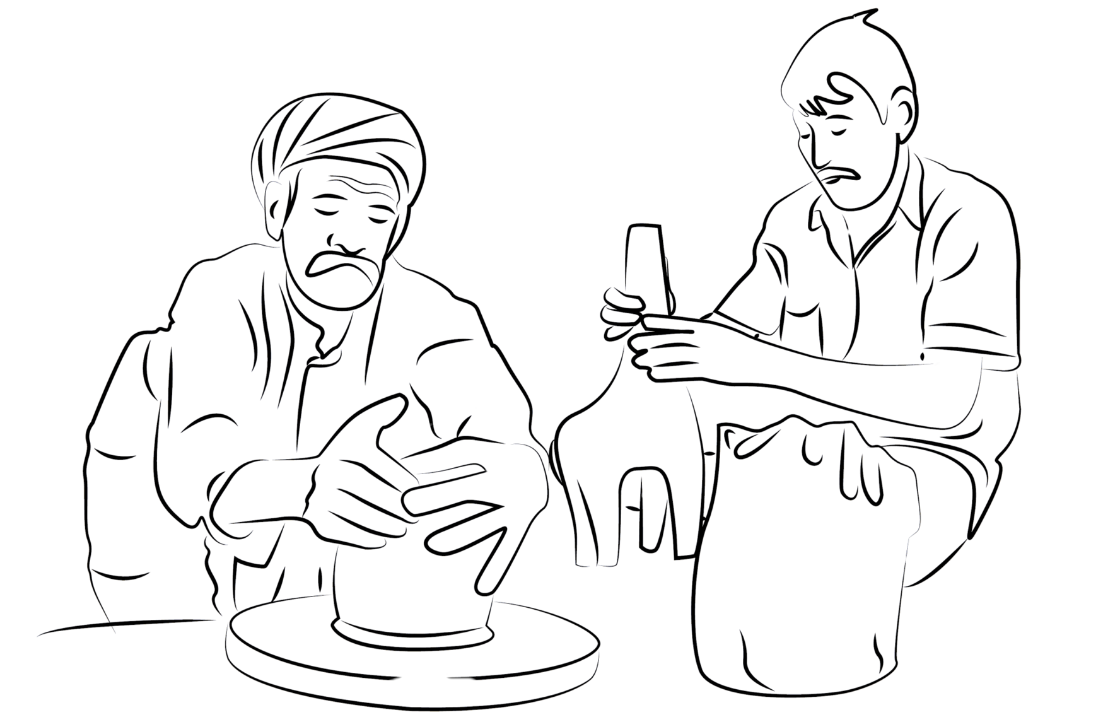
Molela Clay Work
Other Mud Based Crafts

History
The craft of terracotta idol-making in Molela, near Udaipur, originates from a legend of a blind potter who regained sight after crafting an idol of Lord Devnarayan. Today, his descendants continue the tradition, sculpting Dharmaraja idols. Molela, known as the "potter's village," houses around 40 Kumhar families specializing in terracotta art. Bhil, Gujjar, and Gajirat communities purchase these idols, while artisans engage in agriculture during off-seasons for additional income.
Raw Materials and Tools
The raw materials include locally sourced clay (Alu for throwing and Nada for coiling) mixed with 20% dried, sifted donkey dung. Tools used include a stencil, measuring scale, "badli" (a small metal tool), and a brick-built circular kiln (Awara) for firing.
Process
In Molela, terracotta plaques are crafted using locally sourced Alu (fine gray) and Nada (coarse black) clay, mixed with 20% dried donkey dung for strength. The clay is kneaded, shaped into slabs, and cut using stencils. Rolled coils outline designs, while details are added using coiling and pinching techniques. After drying, plaques are fired in an "Awara" kiln at 600–700°C for 4–6 hours, stacked on cow dung cakes to ensure even heating.
Design and Color
The common representations in Molela clay craft include nine Durga incarnations, Deonarain, Bhairavanath, Dharmaraja, Gangaur, Dashavataras, Nav grihas, Shrinathji, Gauri nritya (a religious dance from southern Mewar), scenes from the Ramayana, and ordinary village life. In recent years, artisans have also started to develop modern scenes like doctors, classrooms, and aeronauts.
Product Range
These stories span a variety of product categories, including tiles, vases, toys, and the increasingly popular murals that are typically commissioned to be installed in modern, urban structures.
Additional Information