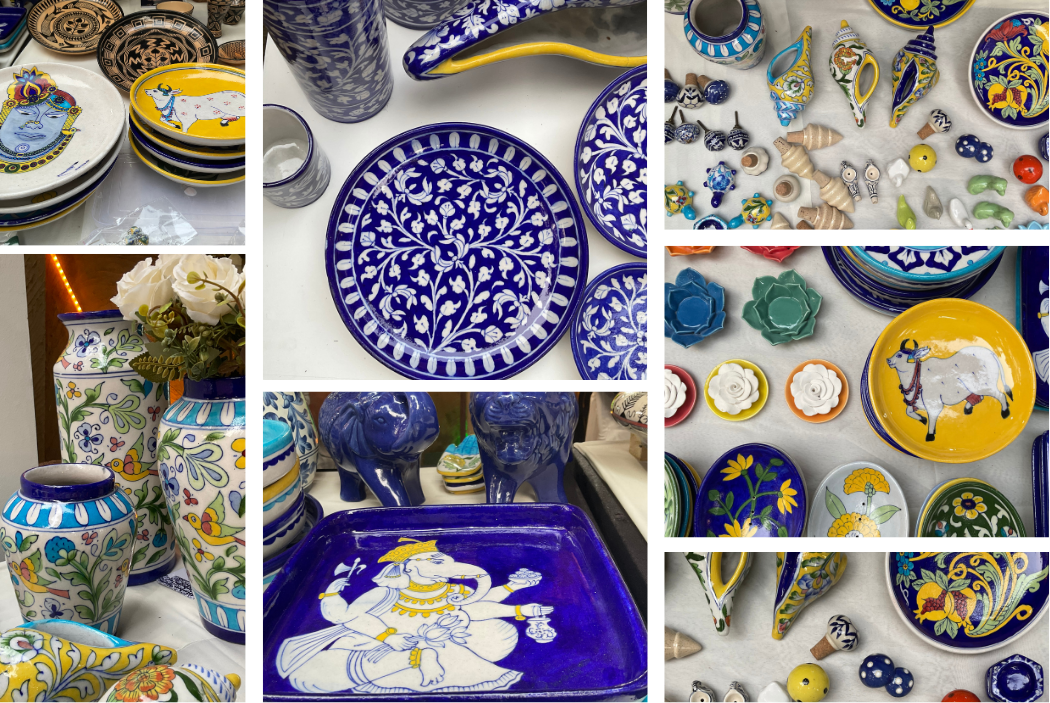
Blue Pottery of Jaipur
Terracotta & Pottery works

History
The Mughals introduced the indigenous art of blue pottery to India, and the then-ruling Maharaja brought it to Jaipur, where it was supported. The craft flourished in Jaipur as the locals received instruction from a select group of Persian artists. Later, an institute was established by the late Shri Kripal Singhji to teach this dying craft. Many artists and non-artists enrolled in the course to learn blue pottery.
Raw Materials and Tools
The raw materials used in blue pottery include quartz powder, Multani Mitti (Fuller’s Earth), scrap glass, Katria Gond (natural gum), Saaji (a sodium-based compound), Plaster of Paris (POP), water, flour for coating, natural oxide colors like blue, green, yellow, and brown, and a glaze mixture made from powdered glass and other chemicals. The tools required for the process include POP molds for shaping, a small broom and iron knife, a stone base and sandpaper, and brushes. A kiln is used for firing the pottery at a high temperature of 800–850°C, ensuring durability and a glossy finish.
Process
Blue pottery is made by grinding quartz powder, Multani Mitti, glass, Katria Gond, and Saaji into a dough. Shaped in POP molds, pieces are dried for 1–2 days, refined, and coated with a slurry. Artisans hand-paint designs using natural oxide colors, then apply a glaze. The items are kiln-fired at 800–850°C. After cooling, they're cleaned, inspected, and packed, resulting in vibrant, durable handcrafted pottery.
Design and Color
In the past, blue was a rare and expensive color, making blue pottery a symbol of refinement, wealth, and prestige. During the Mughal era, it was highly valued by the royal court and the upper class, who prized its beauty and exclusivity. The use of cobalt blue in decorative items and tiles signified luxury and sophistication.
Product Range
Surahi (arrow-necked water jugs), flower vases, cylindrical jars, plates, small bowls, ashtrays, essence holder, lamp stands, coasters, mirror frames, soap dishes, paper weights, T-light holder, photo-frames, napkin rings, boxes for trinkets, games, cups, mugs, tea sets, snacks tray, glazed tiles, and decorative wall hangings.
Additional Information