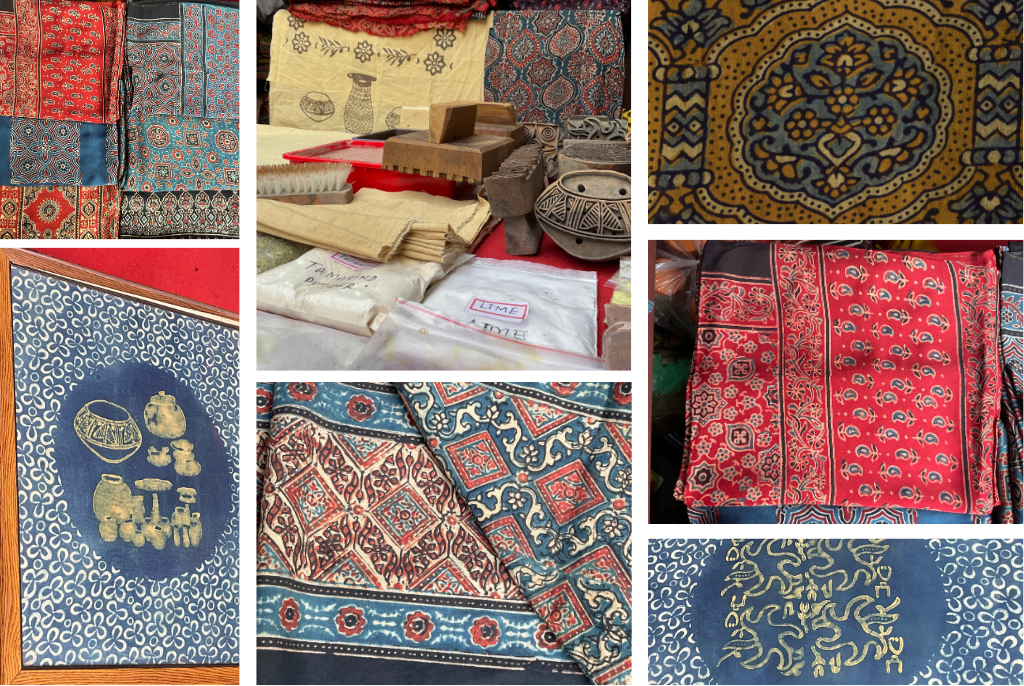
Kutch Ajrakh
Hand Block Printing

History
Ajrakh printing is an ancient craft originating in Sindh, Pakistan, later flourishing in Kachchh, Gujarat, after the Khatri community migrated there 500 years ago. The name comes from the Arabic word "azrak," meaning blue, a dominant color in Ajrakh prints. Traditionally used for Maldhari herders' clothing, it became auspicious in Khatri weddings. Today, Ajrakh is recognized by UNESCO and adapted into modern fashion and home decor.
Raw Materials and Tools
Ajrakh printing primarily uses cotton fabric, natural dyes like indigo, Indian madder, and alizarin, and mordants such as myrobalan and alum. Resist agents like gum Arabic, red clay, and tamarind seed powder create intricate patterns. Artisans use hand-carved wooden blocks, a printing table, and a naand (indigo dyeing vat) for coloring. These tools ensure the craft’s signature vibrant, long-lasting designs.
Process
Ajrakh printing involves 14 stages, including washing, harda mordanting, and resist printing with gum and clay. Intricate designs are stamped using wooden blocks, then dyed in indigo and alizarin for vibrant contrasts. Repeated dyeing and printing create symmetrical patterns, followed by washing and sun-drying to reveal the final design.
Design and Color
Ajrakh designs feature geometric symmetry, inspired by nature, folklore, and Islamic art. Motifs include stars, flowers, birds, and fish, symbolizing heritage and storytelling. The color palette revolves around deep indigo, rich red, earthy black, and white achieved through natural dyes and mordants. The resist-dyeing technique ensures vibrant contrasts, making Ajrakh prints unique and timeless.
Product Range
Ajrakh prints are used in traditional and contemporary fashion, including saris, dupattas, kurtas, and stoles. Men's apparel features shirts, jackets, and turbans, while home decor includes cushion covers, table runners, and bedspreads.
Additional Information
- GINWALA, Anahita., et al. Ajrakh: heaven’s imprint on desert sands. Gandhinagar: National Institute of Fashion Technology, 2010.
- RAJ, Atul. Ajrakh: study of traditional textiles of Gujarat. New Delhi: National Institute of Fashion Technology, 2014.
- SHAH, Dhara., et al. Craft document on Ajarakh of Barmer. Gandhinagar: National Institute of Fashion Technology, 2010.